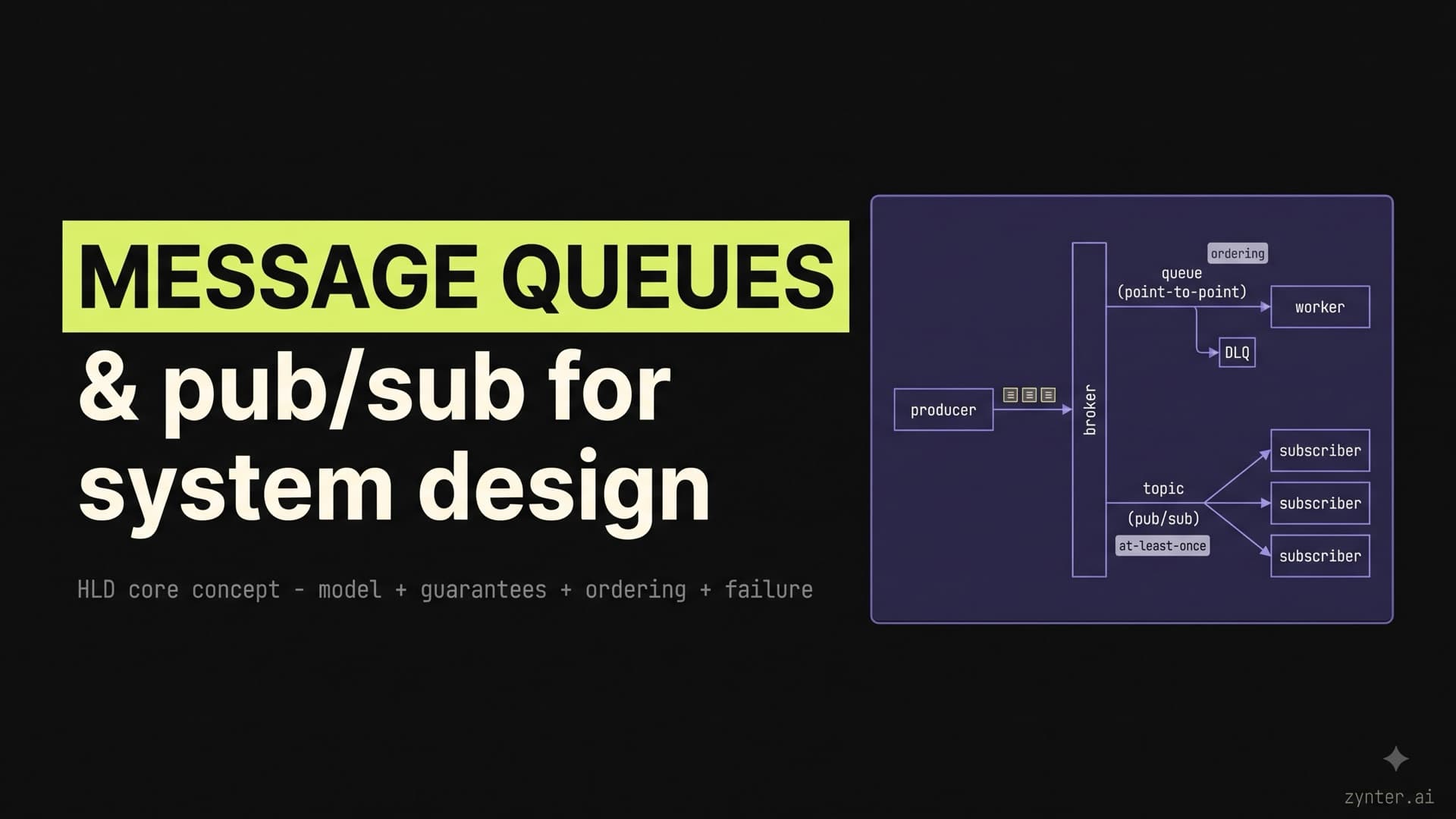
Message Queues and Pub/Sub Explained for System Design Interviews
How to reason about message queues and pub/sub in a system design interview — why asynchronous messaging decouples services, queue (point-to-point) vs publish/subscribe, the delivery guarantees that decide everything (at-most-once, at-least-once, exactly-once), and the hard parts interviewers probe: ordering, idempotency, backpressure, consumer groups and the dead-letter queue — with the follow-ups you answer out loud.
October 24, 20261 min read
Almost nobody freezes on the code. They freeze on the follow-up.
Answer a real round to a voice interviewer that keeps asking why. No scheduling, no subscription, first session ready in under a minute.
Keep reading
All posts
AI Mock Interview: How to Practice Coding & System Design Out Loud
Most candidates do not freeze on the code — they freeze on the follow-up. This guide explains the AI mock interview: a voice interviewer that asks follow-ups while you write and run real code or draw a system design, then hands you a scored debrief — and how to use it to practise coding and system design out loud. How it compares to grinding problems, reading guides, human mocks and live interview copilots, and how to get the most from each session.
Gowtham PotureddiNov 7, 202610 min read
Data Engineering Interview Questions: Complete Prep Guide (2026)
A complete 2026 prep guide to the data engineering interview — the five-round loop (behavioural plus SQL, Python, data modelling and pipeline design), the skill areas and the questions each one tests, the SQL and modelling topics that come up most, the pipeline and big-data concepts senior rounds weight, and the one thing that separates a hire from a no-hire: explaining why your answer is right, where it breaks, and what you'd ask — out loud.
Gowtham PotureddiNov 7, 202610 min read
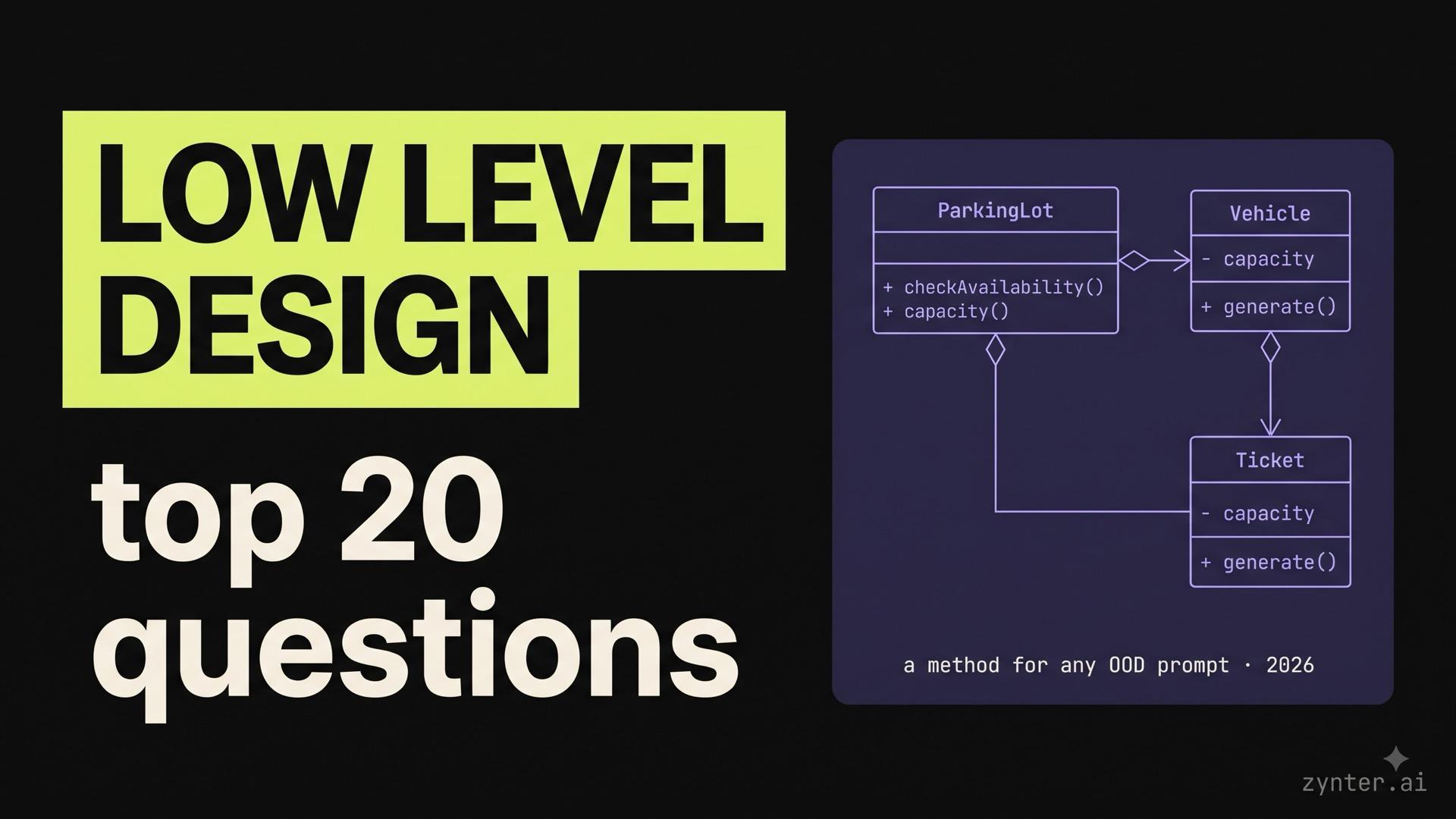
Low Level Design Interview Questions: Top 20 LLD Problems (2026)
The 20 low level design interview questions worth knowing in 2026, organised by difficulty from the parking lot to Splitwise and ride-sharing — plus a repeatable five-step method that solves any of them: clarify the requirements, model the entities as classes, define the interfaces, apply the right SOLID principles and design patterns, and handle the concurrency race. The patterns that recur, the follow-ups that decide the round, and how to practise an LLD answer out loud.
Gowtham PotureddiNov 7, 20269 min read